


7 April 2026
Digital sales enablement: “classic” and interactive tools that accelerate conversion
According to a 2023 TrustRadius study, 87% of B2B buyers prefer to independently research a product or service before engaging with a sales representative. Other research (including Gartner and Forrester) confirms that buyers complete most of the purchasing journey on their own, with many decisions made before the first contact with sales.
B2B sales materials – what do you risk without them?
Many companies realize this too late when sales content is suddenly needed “right now.” Sales teams scramble to put out fires, while marketing operates reactively. Presentations, proposals, and case studies are created under pressure, often at the expense of clarity and consistency.
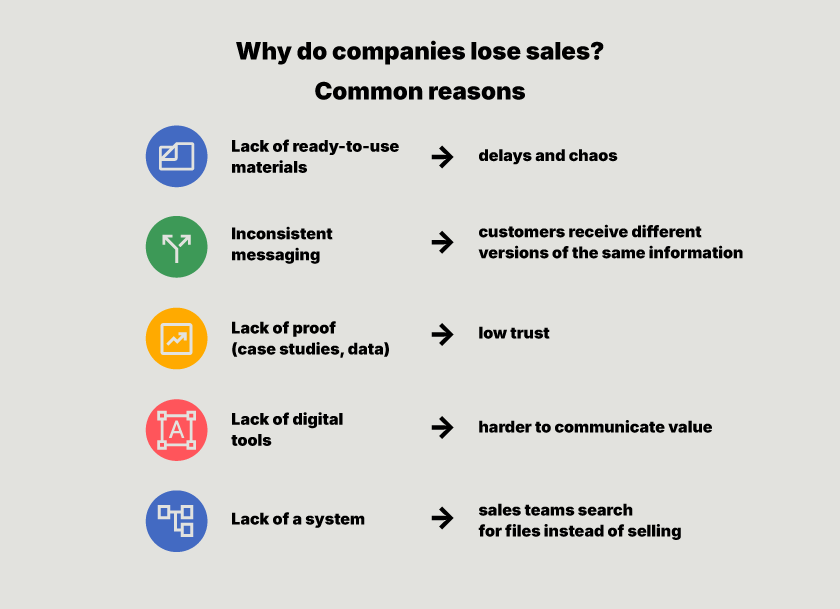
This chaos can be avoided with a proactive approach. Delaying action only increases risk. A lack of structured communication and professional digital sales tools exposes companies to:
- lower conversion rates, as customers fail to understand the product’s value,
- longer sales cycles, as sales reps must explain everything from scratch instead of guiding decision-making,
- customer churn to competitors who communicate similar offerings more effectively,
- lack of message control and organizational chaos, as sales teams create materials independently,
- loss of trust, as customers cannot access reliable, official sources of information,
- reputational damage because the absence of professional sales content in B2B is a major red flag.
What content and tools accelerate conversion?
Simply put: a lack of sales materials is a serious business constraint. Clear and well-structured sales communication is the foundation of customer relationships. If competitors do it better, they are likely already capturing your leads.
Some gaps can be filled relatively quickly but not hastily. Consistency, clarity, and logical structure are key. Content should be built around customer needs and challenges, clearly explain the product or service, and highlight its benefits.
Where possible, materials should be developed as templates, allowing sales teams to easily adapt them to specific sales contexts.
Which sales materials work best in B2B?
• Sales presentations
A core sales tool. Well-designed presentations should be easy to customize, enabling different conversation paths depending on the client.
• Case studies
Highly effective because they showcase real-life implementations and results. The formula is simple: customer problem → solution → measurable outcomes.
• Testimonials
Short customer endorsements confirming the value of a product or service, often highlighting tangible results (e.g. increased revenue, time savings, process improvements).
• Product one-pagers
Concise, single-page summaries of a product or service, ideal for follow-ups after an initial conversation.
• Expert articles, reports, and e-books
In-depth educational and analytical content helps prospects understand key topics before engaging with sales. In B2B, these are often the first touchpoint with a brand.
• Sales FAQs
A collection of frequently asked questions that shortens sales conversations and reduces the burden on sales teams.
• Proposal templates
Modular documents or generators that allow sales reps to assemble tailored offers quickly reducing preparation time from hours to minutes.
• Analytical materials
Benchmarks and solution comparisons that help clients evaluate the value of an investment.
Boosting sales with digital tools: mini apps and interactive content
Presentations, case studies, and FAQs are the baseline. Without them, professional sales communication is nearly impossible. However, in many industries, they are no longer enough to stand out.
That’s why companies are increasingly adopting dedicated digital tools such as mini apps and interactive content. These solutions are easy to use, more engaging than static materials, and often more effective at explaining complex offerings.
They support both the customer and the sales team helping move faster from conversation to transaction.
Importantly, B2B digital sales tools don’t require large investments or complex CRM implementations (although those have their benefits). The focus is on lightweight solutions often developed with specialized agencies that clearly present the value of a product or service.
What works best in B2B?
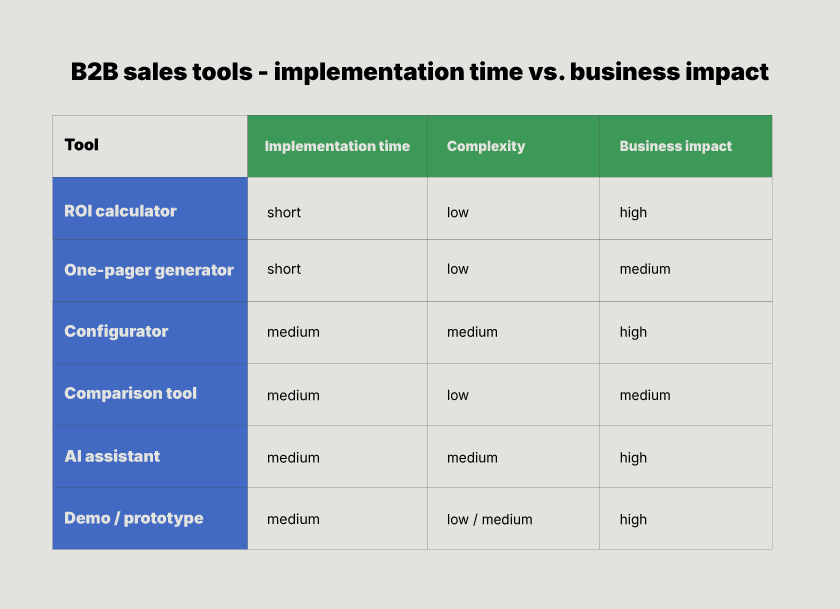
• ROI and savings calculators
One of the most effective sales tools. Sales reps or clients input key data (e.g. costs, scale, working time), and the system automatically calculates potential ROI, savings, or efficiency gains. Particularly valuable in tech and manufacturing, where business impact is the main selling point.
• Product configurators
Allow customers to tailor solutions to their needs. Users select parameters, features, or variants, and the system generates possible configurations. Sales reps receive a ready-made brief, enabling more focused conversations.
• Solution comparison tools
Mini applications that compare your offering with alternatives on the market. The goal is not just price competition, but transparent comparison of features, costs, and parameters helping customers make informed decisions faster.
• AI assistants (based on internal documentation)
More companies are implementing internal AI tools trained on company knowledge offers, manuals, presentations, and case studies. Sales reps can ask questions and instantly receive answers, without searching through files or emails.
• Interactive demos and prototypes
Especially in tech industries, clickable prototypes and interactive demos are replacing static documents. Customers can explore core functionalities before committing to implementation.
No system, no scale. How to manage B2B sales materials
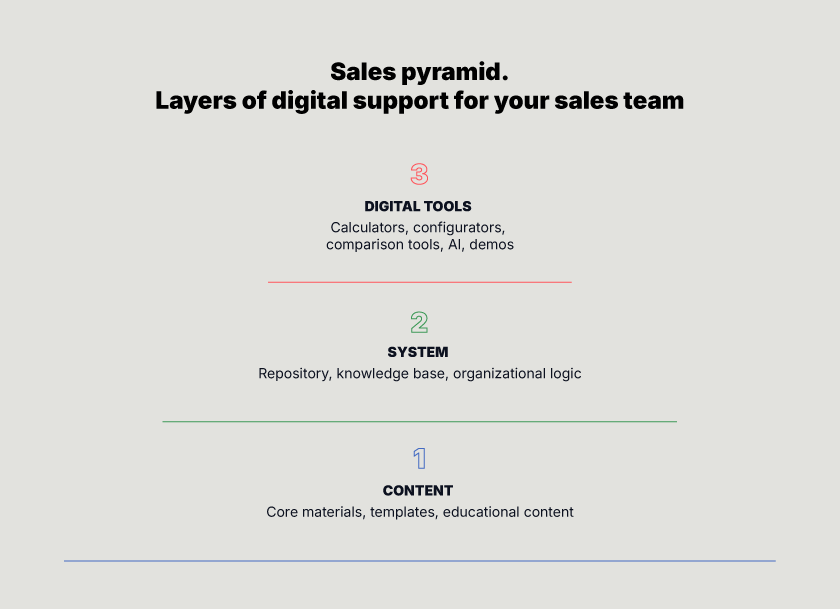
Even the best materials won’t help if they’re scattered across emails, folders, and personal files. A structured sales knowledge management system is essential for quickly accessing and using the right content.
The goal is a well-organized system that allows sales reps to find what they need in minutes rather than wasting time searching or recreating materials from scratch. Such a system typically includes:
• Repository
A central hub for key sales materials presentations, proposal templates, case studies, product documentation. Just as important as storage is a clear, logical structure.
• Knowledge base / sales wiki
A structured source of truth about products, services, and sales processes. It ensures knowledge is shared across the organization rather than siloed. It may include:
- product descriptions and features,
- sales conversation frameworks,
- key value propositions,
- answers to difficult customer questions.
• Templates and modular structure
Sales materials should be easy to adapt rather than created from scratch each time. Templates enable:
- shortening or expanding content,
- swapping presentation or proposal modules,
- quick customization for specific clients or industries.
Building a complete set of sales content and enablement tools may seem challenging. In practice, it’s a matter of gathering the right data and applying a structured approach.
As your knowledge base grows and becomes organized, every next step becomes easier. The reward is significant consistent content and tools not only streamline the work of sales and marketing teams but, most importantly, drive customers toward purchase decisions.
If you need help creating content and digital solutions that support your sales, get in touch with us.