


26 March 2026
Marketing automation is the essential you can’t afford to miss
Marketing without technology doesn’t exist. The days when marketing relied purely on creative intuition are long gone. Today, any company aiming to turn advertising into measurable revenue must optimize its activities and track performance using IT tools. Marketing automation plays a key role in bringing order to complexity and delivering tangible results.
Who needs marketing automation (and who might not)?
Marketing automation (MA) refers to a set of tools and processes that enable the automation of marketing and sales communication from email campaigns and notifications to lead scoring and real-time content personalization. The benefits are substantial:
- faster and more effective customer relationship building,
- higher conversion rates,
- more efficient marketing spend (lower costs, better outcomes).
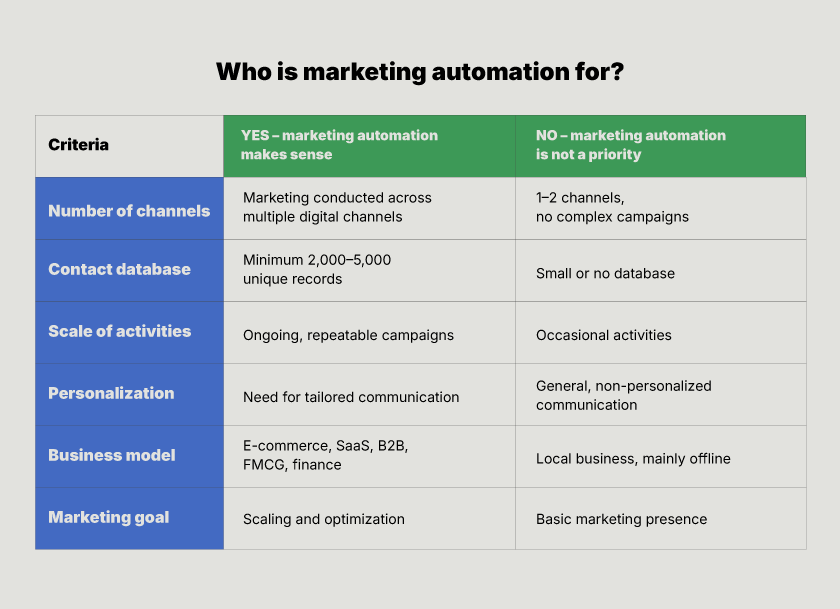
These tools are particularly effective in industries such as e-commerce, SaaS, finance, telecommunications, B2B businesses with long sales cycles, and FMCG where personalization and customer retention are critical.
However, not every business will benefit equally. Small, local companies or those operating primarily offline may not see significant results from full-scale automation. That said, even they can gain value from simple automations such as email reminders or SMS notifications.
Where does marketing automation deliver the best results?
Marketing automation performs best in environments with large volumes of data and repeatable user behaviors. In such conditions, it significantly enhances effectiveness in areas like:
- lead generation and nurturing – automated segmentation and guiding prospects through sales funnels,
- e-mail marketing and omnichannel communication – delivering personalized messages at the right time, often triggered by user behavior,
- retention marketing – keeping existing customers engaged through abandoned cart reminders, product recommendations, loyalty programs and more,
- user interaction tracking and campaign performance measurement.
How to measure marketing automation performance
One of the biggest challenges in marketing is limited measurability. Marketing automation addresses this directly.
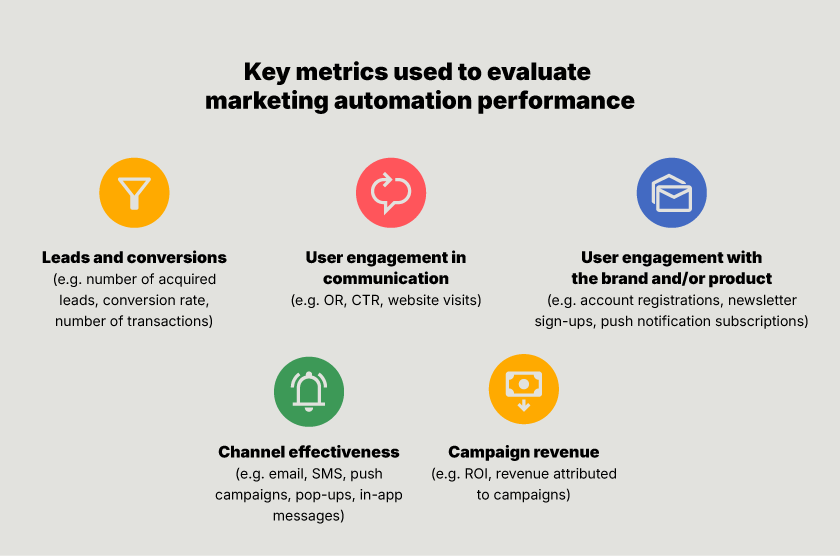
MA tools enable precise tracking of customer behavior and detailed analysis of campaign performance. This data makes it easier to calculate return on investment (ROI) and optimize campaigns reducing spend in underperforming areas while scaling what works.
What are the best MA tools?
There is a wide range of marketing automation tools available, differing in functionality, supported communication channels, scalability, ease of implementation, and pricing. Choosing the right solution depends on your business needs, technical capabilities, and growth plans.
The most common categories include:
dedicated marketing automation platforms:

integrated marketing and sales platforms:

What do you lose by not using marketing automation?
Implementing new solutions can be challenging, but the cost of inaction is often higher. For companies reliant on effective online marketing, delaying MA implementation can lead to:
- limited control over campaign performance,
- underutilization of data for personalization and targeting,
- wasted time, effort, and budget on manual processes.
A lack of automation also means losing the ability to manage the full customer lifecycle effectively. Marketing automation supports communication at every stage, from onboarding and education to engagement, win-back campaigns and post-purchase service. Without it, companies struggle to respond to customer behavior in real time, making it harder to build loyalty and meaningful relationships.
Generic, poorly configured campaigns lacking strong data and automation fail to address real customer needs. This increases the risk of losing both leads and existing customers to competitors. Ultimately, ineffective marketing leads to weaker business performance and team frustration, especially when automation could unlock significantly greater potential.
What are the main barriers to implementing marketing automation?
Not all companies that could benefit from marketing automation are ready to implement it. However, many of the barriers are broader business challenges that need to be addressed regardless:
- lack of a clear strategy and goals – automation without defined KPIs can increase chaos rather than efficiency,
- data silos and lack of system integration – disconnected data sources (CRM, e-commerce, social media) prevent a unified customer view
- limited resources or expertise – MA requires specialists who can design automation workflows and analyze data,
- organizational constraints – automation changes how marketing and sales teams operate, which may create resistance or internal friction.
Marketing automation audit – why is it worth it?
For many companies, overcoming these barriers is critical to staying competitive. Failing to invest in tools that effectively support sales leads to rising costs and a growing gap versus competitors.
However, achieving a strong ROI requires a clear implementation plan and team education. Only then does marketing automation become a true growth driver, not just another IT project.
Many companies that have already implemented MA tools use only 20–30% of their capabilities due to a lack of strategy or know-how. In such cases, an audit can help identify bottlenecks and uncover optimization opportunities.